The shower-room fight over George
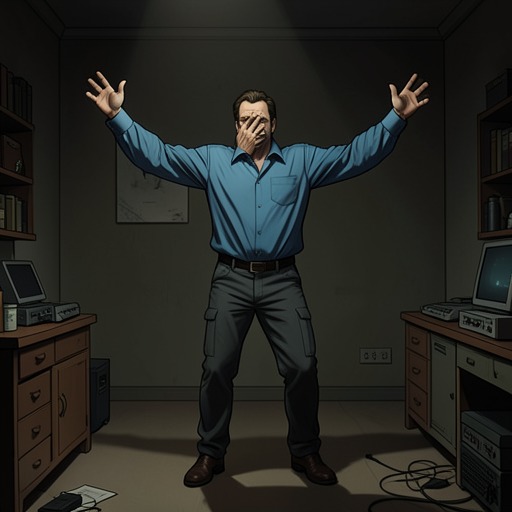
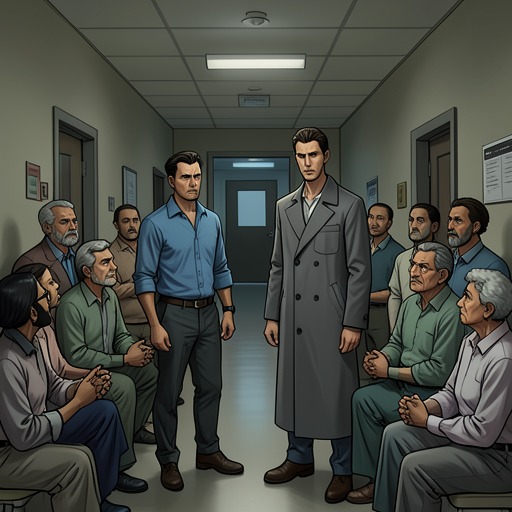
One Flew Over the Cuckoo's NestThe shower-room fight over George turns a routine act of coercion into a test of whether the patients will leave one of their own to face it alone. When Washington presses George to accept a treatment he refuses, McMurphy intervenes; the confrontation escalates into a fight involving McMurphy, the other aides, and Chief Bromden. The scene’s decisive reversal is that a moment of helplessness becomes a collective stand, even as the ward’s authorities answer it with restraints.
Background and Stakes
George has long refused to use soap when he showers and will not let anyone hand him a towel. The aides on the Tuesday and Thursday evening shifts have generally left him alone rather than force him to change his habits. That history makes the encounter a breach of an established accommodation: Washington now approaches George with a tube of salve, while George leans back, shakes his head, and covers himself with his large hands.
The other men first respond to the shower-room scene with laughter and teasing. But when Washington stops in front of George, the room falls silent. The narrator registers a collective recognition: the patients understand what is about to happen, why it is happening, and why their earlier view of McMurphy has been wrong. The sudden quiet marks a change in the stakes. What had looked like comic spectacle is now a question of whether anyone will act when George is cornered.
Washington tries to make the treatment seem necessary by invoking bugs and crabs. George repeatedly refuses, while Washington advances the tube and turns the threat into a grotesque joke. The taunting does not remove George’s fear or make his refusal less clear. Instead, it lets the aide press forward while the other patients watch. McMurphy’s brief order to Washington interrupts that routine, and the room’s attention shifts from George’s resistance to the confrontation that follows.
McMurphy Intervenes
McMurphy crosses the shower room and shoves Washington away from George. His appeal is not triumphant: the narrator hears helpless, cornered despair in his voice. That detail complicates the intervention. McMurphy acts decisively, but he does not control what his action will unleash; the words and gesture are an attempt to stop Washington, not a guarantee that George is safe.
Washington answers by presenting the impending violence as self-defense and asking the other aides to confirm his claim. He sets down the tube beside George, swings, and catches McMurphy by surprise across the cheek. McMurphy staggers into the line of naked men, who catch him and push him back toward Washington. After another blow, he stops reacting as though the fight can still be avoided and begins to defend himself.
The men’s formation changes with the conflict. A quiet line of showering patients becomes a shouting circle around the combatants, their bodies closing into a ring. Washington is taller, with longer arms and faster punches; McMurphy takes repeated blows while advancing in short, flat-footed steps. The fight moves back and forth across the room. The patients urge McMurphy to finish Washington, but he does not appear to hurry. The contrast between Washington’s reach and McMurphy’s forward persistence makes the struggle a physical contest, while the watching men’s circle makes it a public one.
The Fight Widens
As McMurphy continues to press forward, Washington looks toward the other aides and calls for help. One grabs McMurphy from behind, but McMurphy shakes him off. Bromden then picks up an aide and throws him into the shower; the narrated image emphasizes that the man is full of tubes and seems to weigh only ten or fifteen pounds. Bromden’s intervention makes the fight a direct action of his own, not merely a scene he observes from the crowd.
The least of the aides runs from the room. Another gets behind Bromden, locks his hands behind Bromden’s neck, and bites him. Bromden breaks the hold. Meanwhile, McMurphy is still fighting Washington. The scene therefore does not resolve into a simple one-against-one contest: the aides’ attempts to restrain the interveners repeatedly draw Bromden and McMurphy into fresh physical danger, and each patient’s action changes what the others can do.
Aftermath and Significance
By the time the fleeing aide returns with straps, cuffs, blankets, and four more aides from Disturbed, the men are dressing and shaking hands with McMurphy and Bromden. They describe the fight as a tremendous victory and say that the aides had it coming. Their talk is meant to cheer the two men, but the celebration does not determine who has authority over the aftermath. Nurse Ratched helps the arriving aides adjust soft leather cuffs around their arms.
That ending holds victory and punishment together. The patients have broken their silence and acted in support of George; Bromden has joined McMurphy in confronting the aides, and the men around them respond with fellowship rather than distance. Yet the institution can still remove the fighters from the ordinary ward and restrain them. The fight thus gives the patients a moment of solidarity without pretending that solidarity has undone the ward’s power. Its lasting turn is the recognition that McMurphy’s apparent defiance is also a willingness to put himself in danger when George cannot protect himself.